DAY 1:
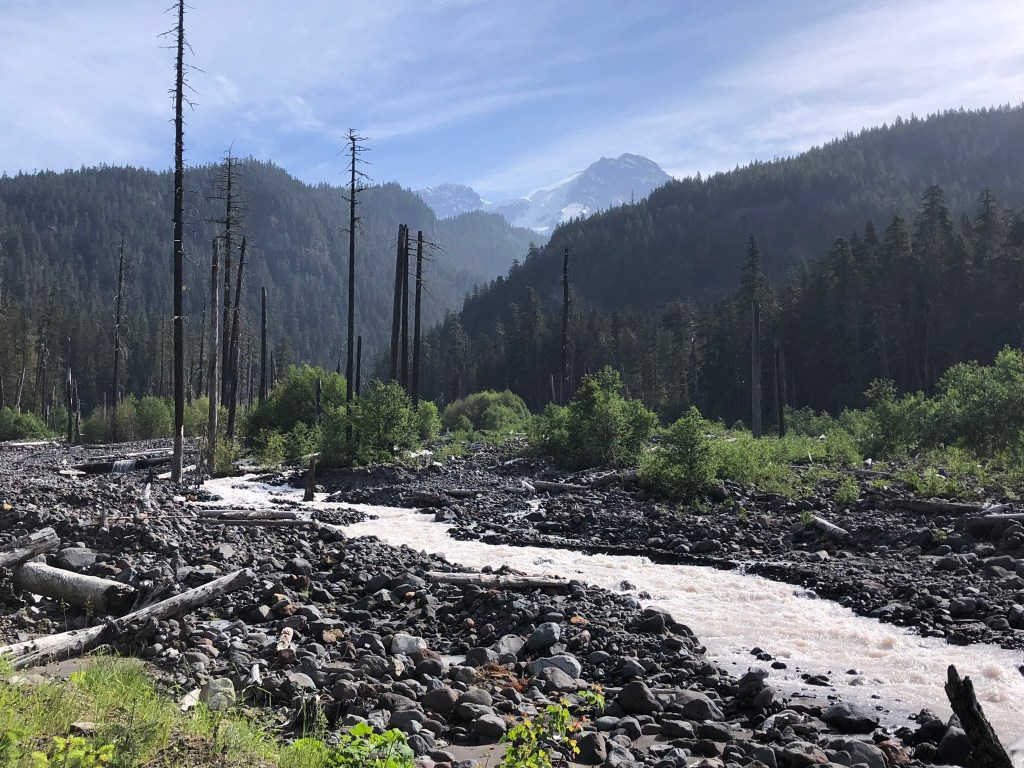
Nature is raw at 4,300 feet above sea level. Wind courses through pine branches unharnessed. Water tumbles and crushes rocky beds with abandon. The sun scorches.
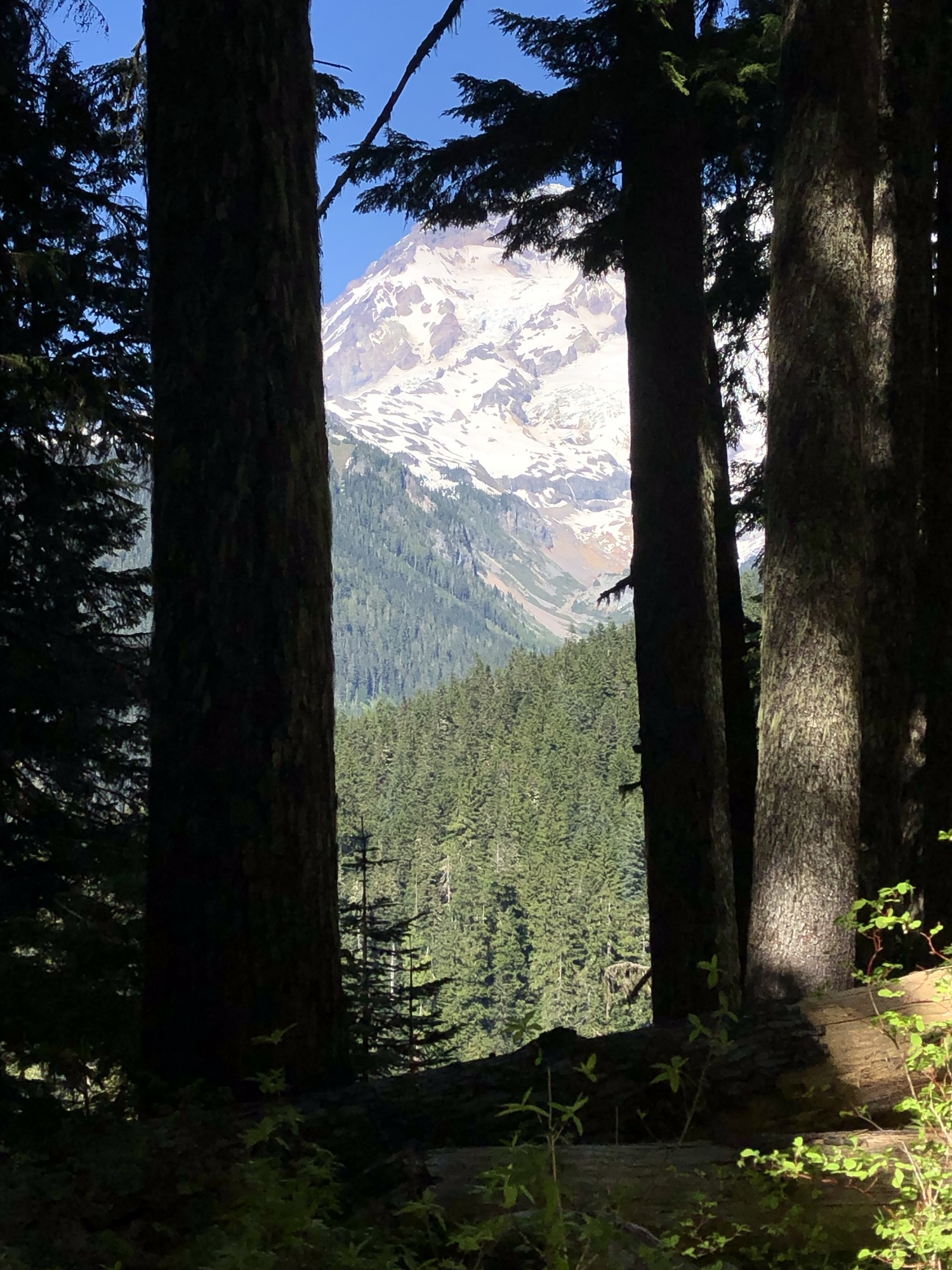
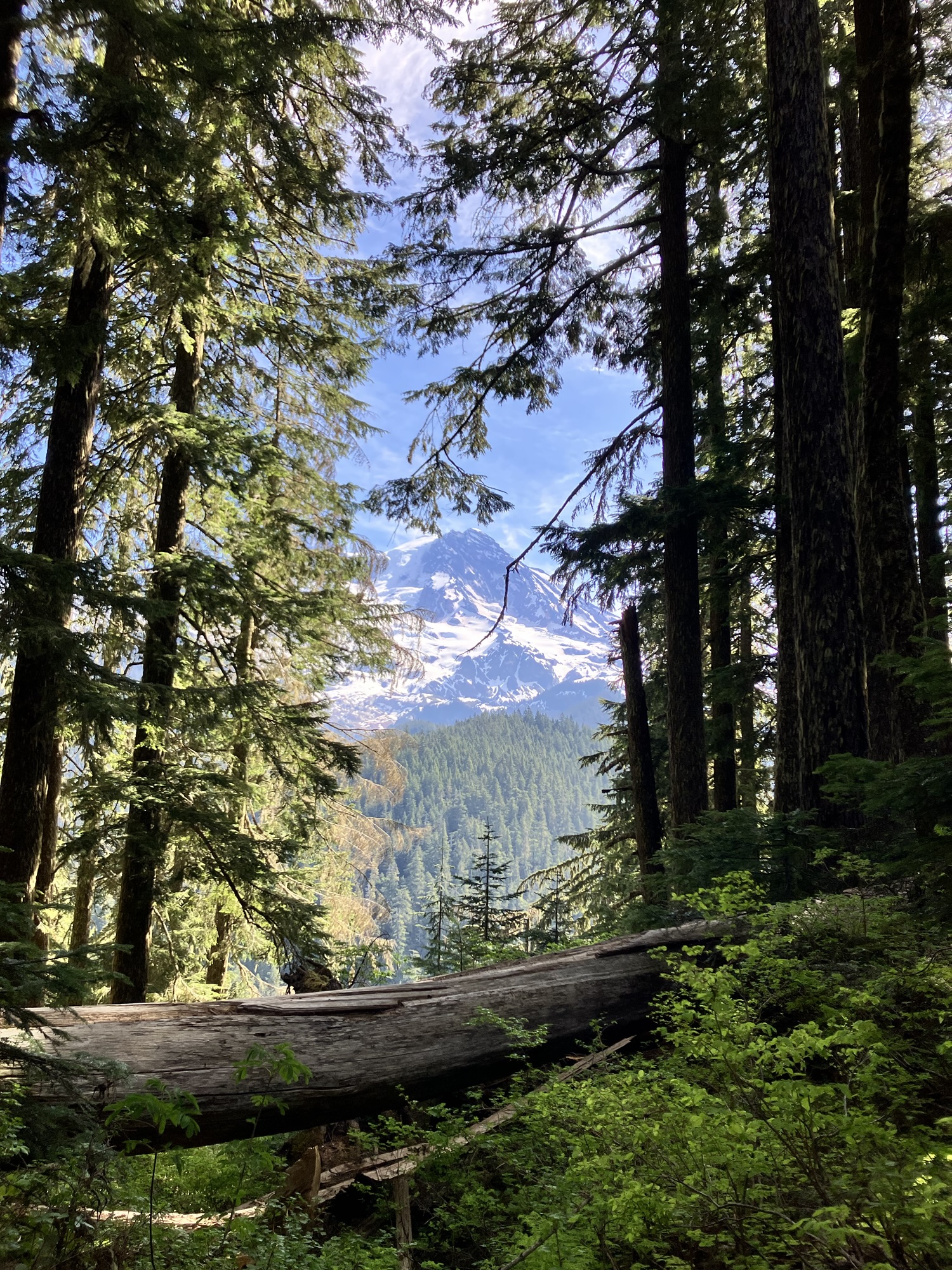
My daughter and I are backcountry camping for three days and nights on a western ridge in Mount Rainier National Park. From our primitive, backwoods camp site, the dormant volcano is still blanketed in white on this early June morning. Its stark, colossal summit emerges like a beast behind the pine trees that ring our site, its reflective brilliance a bold contrast to the dark green of the swaying pine branches and firmly rooted trunks pushing up to the sky. Mt. Rainier appears imposing yet reassuring and so near. I feel like I could throw a stick and it would stick into its bank, slowly melting its mask into rivulets of cold mountain water trickling down like tears.
It’s our first time backpacking into backcountry. After speaking with a ranger at the Longmire Visitor Center, one of the southern entrances to the park, our itinerary changes. The 10 mile trail we ambitiously planned to hike the first day was still snowed over. The ranger gives us other options: return west a bit and up a gravel road or on to Cougar Rock campground to the east. We decide on the option to the west. This gives us a short 4.5 mile hike the first day and even shorter hike to the next primitive site the next. We would decide what to do for night three after that.
We leave the car parked overnight up by the gate on the service road paralleling Tacoma Creek. Hoisting onto our backs the 30 lb. packs full of gear, food, and clothing that will sustain us for three nights out in the wilderness, we feel strong and sure footed. After a mile holding a steady pace, my legs slow down. I recall my brother’s concerns. “Did you train for this?” “Umm….no.” He kind of chuckled, as if I decided to compete in a 26 K on the day of the race because it sounded fun at the time. Backcountry camping demands certain moxi that front country camping can forgo. It’s quite strenuous to say the least, for the uninitiated for sure, but for the untrained definitely. “Do you have a topographical map?” He asked me. I looked at him blankly. “Do you have a first aid kit?” Wide eyed. “Do you have a bear horn?” I thought this was rather extreme for what my daughter and I had in mind and without further thought put it back on the pile we wouldn’t need, the pile of my brother’s gear that he lent me to pick through for the hikes. Now, the further into the wilderness we hike, the more remote we become, the heavier surviving for three days seems to become. We find shade for breaks. I wonder about the weight of basic needs: shelter, food, water, safety. It takes a lot to stay alive.
Merely 3.5 miles later the gravely service road, from where we parked the car, spills out at a roundabout, ostensibly for mountain bikers who ride up and down here for kicks. I look for the .9 mile trail that will ascend to Lake George camp site, somewhere to the left in the woods, but my daughter S— says that we need to stay on the gravel road, winding around in a hairpin turn, that she points out to me. “We haven’t gone the 3.5 miles yet?” I ask her, in surprise, but mainly in dismay. “Apparently not.” She shows me the map to confirm. “We stay on this road until we see a bike rack.” We trudge on. My muscles hold up and move me steadily on as we incline further up and into the thick of the ridge. According to the park map, Emerald Ridge should be on our right side and Mount “Wow” (actual name on the map) to our left. But the tall pines on either side of the gravel road obscure any landmark for orientation. We trek up the last half of the road eagerly, every foot fall hefting us higher, anticipating the view that will come eventually, the view that earned the mountain its name. Finally, we reach the bike rack. Here, the bikers dismount and join the hikers up to Lake George, .9 miles away. Every tenth is counted up here, every number registers a factor in the survivability of life. There is no latitude for the lazy haze of approximations conducted in civilization.
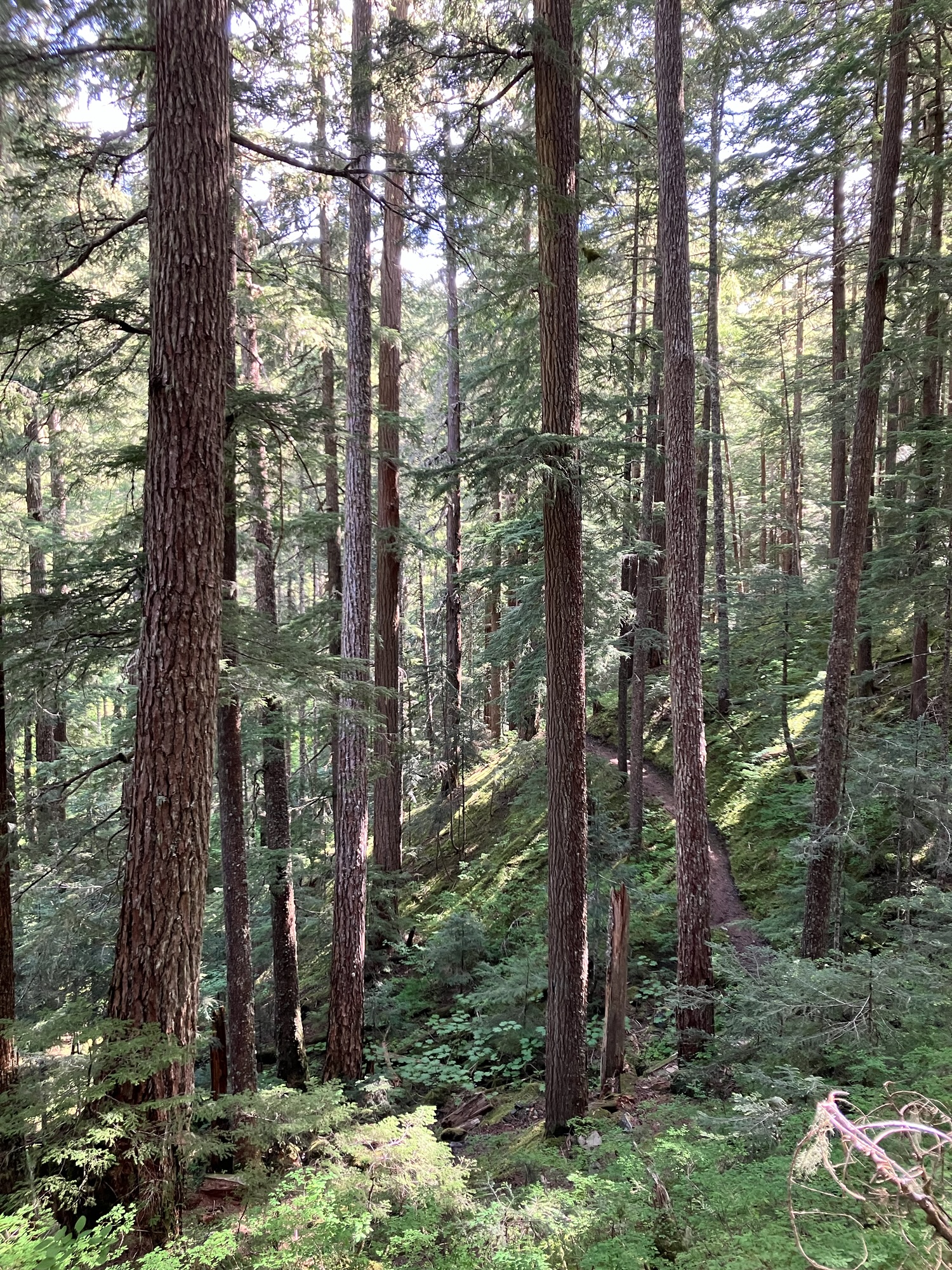
The ascent now begins in earnest up to Lake George. The path is wired through with hardened tree roots and toe stubbing tips of rocks, surfacing from the pine and dirt track like small icebergs from a deep ocean. We stop several times, unstrap, and do some forward bends to stretch out and relax the old back or just sit. I listen to the silence. Altitude seems to deepen it and stretch areas in my mind. Miles lose their measure. Time becomes fluid. Space disfigures parameters. Autonomy is but an ideal. We are as complex as the ecosystems around us and all so dependent on one form or another to get by. So we stand up and strap on and dig in to a faith that every Mount Wow will be there, will greet us, will be all that, and more.
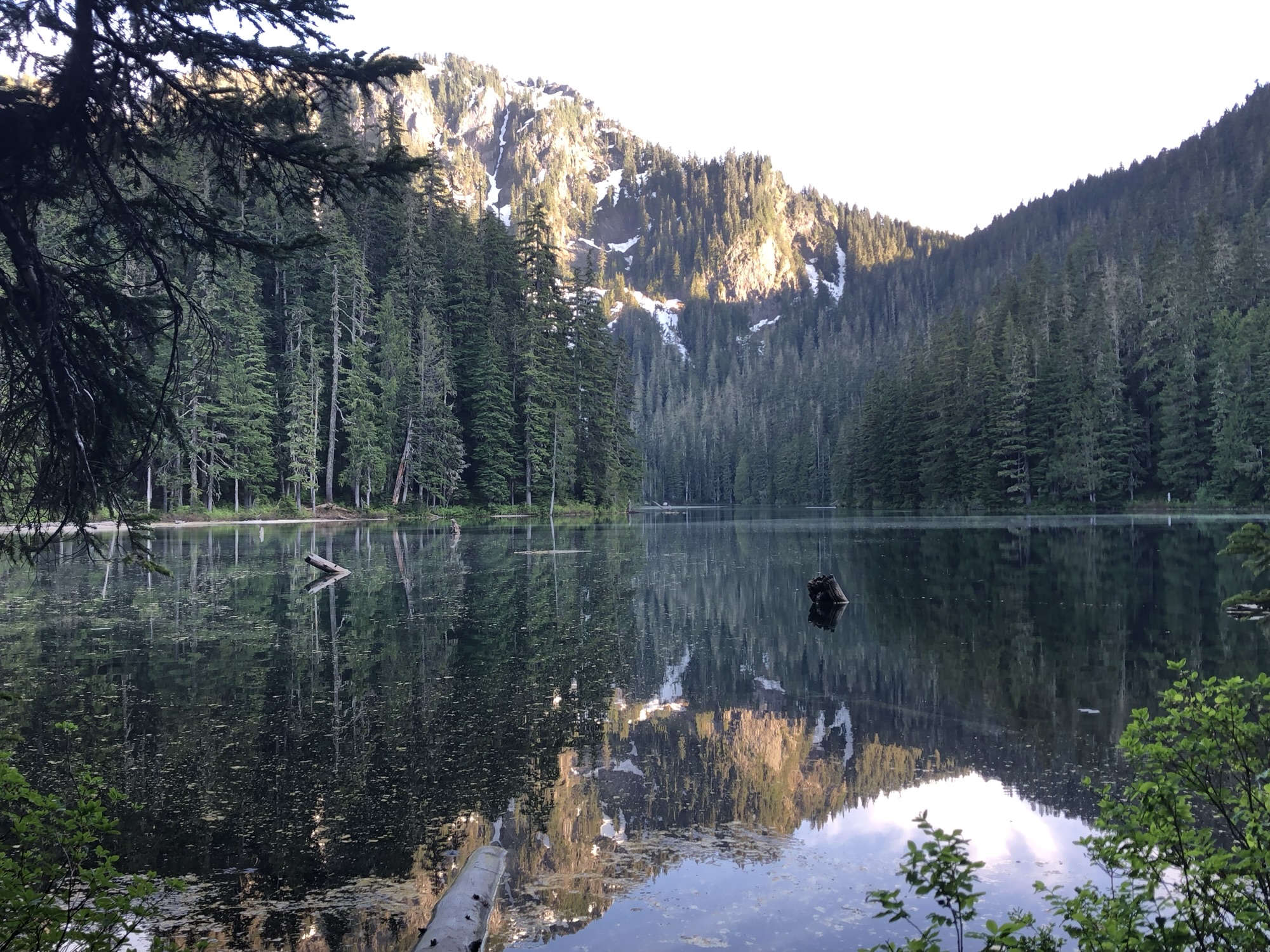
I can’t say that hiking with an untrained body carrying 30 lbs. for ten, four, or even one mile is pleasant, or at all what happy hiking with a simple day pack once was like. After every frequent break from which I felt ready enough for the next .20th of a mile, I looked at the pack with the meditative determination of an Olympic weight lifter before he lifts the 300 lb bar up and over his head. True, I had no training for this, but I can’t see how you’d train for this except to fill a 78 liter backpack with 30 pounds of stuff and hike uphill for 4.4 miles. So I consider this the training, but I can’t think of a deliberately chosen “next time”. Not now, when my thighs are beginning to scream and the shoulder straps pressing in too tight. Soon we crest the last slope, we turn the last curve and in front of us is Lake George, an emerald and turquoise glass plane of still lake water, reflecting all of an inverted Mount Wow in its pool. I drink in the colors and the gift and feel showered with euphoria. The mountain soars beyond, reaching the tips of angels’ wings.
We follow the signs to the camp sites 100 feet up an embankment. Once on top, the rush of running water from a creek way below floats up to us. We pitch our pup tents under Rainier’s watch and light up the small gas burner for hot water. Tonight we’re having re-hydrated beef stroganoff. It’s not half bad when you’re half dead. We eat, comment on our achievement and without the familiar distractions confronting us at home we retreat to our spaces within. S— reads a book on the nature of fungi. I listen to the trees’ conversations: their whispering high in the sky, their branches lifting and intermittent crackling and trunks swaying and creaking. And the birds: whistles and pecking and rattling and jackknifing and cawing – their trills sound pragmatic and necessary, without the frills of song bird melodies that romance us in the valleys. S— tells me later that a rabbit came onto our site and stayed a while, unbemused by our attempt at forest living, and was only frightened away by a falling branch far off. But by that time, I had already retreated into my tent, and could not lift myself from a supine position for the rest of the night.
DAY 2
The sun hidden behind Mount Rainier brightened the sky long before I woke at 5:30. By the time the water in the pot was heated and we were drinking the first of other cups of instant espresso gold, the sun emerged from behind the giant and cast its first rays upon the forest floor. It came as silently as an ocean wave that then suddenly crashes its light upon the verdant tangle, bathing the floor with first heat and waking the dark green shadowy undergrowth from its slumber into a shimmering floral fluorescence.
Feeling recovered, we decide on a mile walk before breakfast, and head down to the lake where paths would take one further up and away. Goat Trail, a unimposing one mile trail, is between a snow melt creek and tall firs. It leads up into an opening which is still swathed in snow, making the continuing trail on the other side indecipherable. So we tread on the crunchy ice for a while, feel the cool creeping up from below our feet before we head back for breakfast: overnight oatmeal with protein powder.
By nine a.m. our ambitions for backpacking to the next site, South Puyallup, were amended and seconded by both of us. We sit in contented stillness after eating, feeling the lightness of being. We agreed unanimously and without reservation despite the one we made that we would leave our tents here, do a 6 mile round trip day hike to the next camp to give our legs and bodies a rest before the 4.5 mile descent, 30 lb-sack-racked-to-our-backs hike for day three. We figure that as long as the rangers know we’re up here somewhere, we’d be ok.
But we need water, of course, and snack bars, a large green apple to share, the first aid kit, the knife and space for the top layers of clothing that would eventually come off. The pack was much lighter, hardly felt its presence at all, and so we take off. We hike back down to the bike rack, and then jaunt over the service road to the trail head to South Puyallup campsite, a narrow wooded trail high above another river. Soon my legs catch on to this trick and they balk against the weight, whether 10, 20 or 30 lbs; they seem to want none of it. We take turns strapping the pack, which now feels like lead. But the forest stimulates my senses and soon the legs quieten in their complaints as the path ascends then descends in camel hump regularity east, closer to watchful Rainier, guarding and guiding us. We pass over many creeks, fully accessible for water bag dipping and filtering into an empty bottle, but we did not know this as we prepared. We talk about next time, now, tentatively, and what we know to bring and not. One 16 ounce camping pot is enough. Replace the 16 ounce crinkly water filter bag with a larger, pliable soft plastic one, easier to fill, easier to squeeze out. A medium sized cocoon sleeping bag is better for leg room and turning. Over a next bend we hear the mangled man-made sound of a chain saw, and conclude the site is within range. Indeed, two rangers are clearing the path and sites of winter detritus. I see a felled tree and feel a comoraderie with it; we collapse on its trunk completely spent. This day trip was nothing like what I remember them to be. We face the east with the sun streaming on our faces and blinding us from what is in front of us. Then I raise my palm to my forehead to block the sun and see nature’s magnificence.
Large, thin diamond shaped columns, sharply chiseled into geometric precision, stand like matchsticks against one another, hold up part of this mountain in front of us. It looks so well designed, as if a sculpturer had walked along here years ago and decided to turn their moment of inspiration (or craving for a super sized side of fries – for this is precisely what they looked like) into artwork. We eat our snack bars and contemplate this phenomenon and how it had formed. I decide to walk up ahead and ask the loggers. This is what I learn: when Rainier erupted, periodically over the millennia, it sprung its hot lava through the earth’s crust where it met a thick frozen layer of ice, from an ice age, or from a remaining glacier, and the molecular configuration of the ice crystallized the hot lava into diamond shaped, octagonal, columnar jointing. Enviable. This precision formed by chemical compounds and molecules and atoms. I feel so beneath it all, literally, but also incapably. It must have been with such force, this angry red molten mass moving and grinding its way to light, finally breaking free, spewing a bloody viscous rope into a solid, equally determined, strength of white that froze it into perpetuity.
We lumber our way back to camp; the 6 mile round trip required longer and more frequent breaks. When we arrive back to base camp, we open packs of tuna and roll it up in tortillas and wolf them down. We retreat to our tents where exhaustion takes over. “What are you doing?” I ask her. “Reading my book.” “What’s it about?” “The one about fungi.” I look up through the netting. A circular opening, the result of cleared trees for the site, allows a glimpse of the sky. A far away, silver plane moves slowly across the zenith. I close my eyes and fall asleep.
Regretting that I brought neither reading nor note book to save on pack weight, I lay awhile in the tent long after I wake. The sun is now into the trees in the west, and the air perceptibly cooler. I left my thoughts to roam by themselves, unconfined and unmeasured. I did not feel the need to follow them, analyze or dissect them. I feel the wonderful unaccountability of letting them go. My legs feel weightless and my mind cleaned and unburdened.
It’s my turn to fill up the water bottles and 3 liter “bladder” – a large plastic sack with extended drinking tube that fits into a backpack – soon I will walk down the the hill while the light is still sufficient. I’ll catch the cold stream coming off the snowy field from yesterday into a small bag, screw on the palm sized tubular filter, and then turn it all upside down and squeeze the filtered water into our containers. It’ll take a while, and it’ll freeze my fingers numb from the cold water, but it tastes delicious. I pull myself up and out of the tent.
Towards 7:30, with a lot of daylight left, S— continues to read. I turn to face Mount Rainier. Its steady, icy rock is both endurance and reassurance. It’s placid and uncontroversial. It holds my gaze until my eyes feel heavy again. I feel like I am floating above the flurried movement of the creek as it rushes on, as if it had deadlines to meet, and I think this is: to be held in the arms of a rock, swayed by the currents of water, and lulled to sleep by the songs of the wind.
DAY 3:
My daughter is up first this morning. I hear the clanking and zipping of containers and bags as she extricates the little stove and coffee from the bags and bear pole to start out our morning. She has meted out our meals into breakfast, lunch, and dinner ziplock bags. She has researched and read and compiled lists and reviewed Reddit for best backpacking experiences. She pours hot water into a bag of dehydrated egg, potato and sausage, seals it up, and waits the 5 minutes for it to absorb. I cup my hands around a steaming cup of coffee and watch for the sun to inch upwards over the mountain to split the day from its dawn. We share the breakfast skillet and she says, “Where should we go next?” We open the map, scope out our possibilities. We have mastered the ones that are open to hikers, so we hike back to the car and drive over to Cougar Rock Campground and do a day hike up to Carter Falls from there.
Methodically we seal, zip, roll, collapse, deflate, bag and refill the backpacks with our survival needs. The site is now emptied of possession; dispossessed, returned to the wild. Our exhalations and utterances are carried and left to nature’s time and space. What we take with us are its designs, for as long as they last. The forest has traced us with an outline of truth about ourselves. We are as domesticated as the simple milking cow, as commonly spoiled as the house cat, as dependent as the dog. The wild has been extracted from us long ago, so we return to the asperity of the wilderness for an awakening from the leniency and lull of cultured living.
On the last morning, we sip the coffee in reclining comfort from the back of the car. We take notice and pause in our conversation to watch a dear enter our camp site and how it notices us with the aloofness of the chipmunks and rabbit that visited us in the wilderness. It carries on with its nibbling at some mossy undergrowth. “It would have been different,” I said, “If we saw a dear up there. They all come down to the front country now,” I said, thinking about the posting at the camp’s entrance for bear sightings. They have no fear of us down here. I think of hunters, and ask the question. She doesn’t seem to hesitate. “Only if I had to, I mean to survive, I guess.” “You could?” I didn’t know that about her, but it shouldn’t surprise me when I think of how quickly she adapted up there in the woods, how capable she was with the gear, how knowledgeable she is about surviving. She tells me now about the fungi. While I was musing about the water and woods, she was reading about the fascinating and essential roles of fungi in decomposition – dead matter must be broken down, after all – and in stabilizing and strengthening ecosystems and symbiotic relationships. I listen to this information. She looks at me with a matter-of-factness that contests my soft sensibilities towards nature; that I still hadn’t learned an important lesson out there in the wild. “Mom,” she says now patiently but resolutely, tempering my romanticism with a dose of reality: “nature is essentially violent.” She’s right, of course; it can be brutish and is indifferent to our sentiments and scoffs at our attempts to master it. And yet. Nature’s every breath returns life to our instincts, our own wild. It quietens and resizes us. Its perfect patterns and systems – its wood, water, rock – inform us, if we pay attention.

 Write Down the Road