The Greeks have taken their island back. The Germans and Dutch seem to have been swept up and put on ferries to Mykonos. Since Good Friday, natives have come in like herds of wild, overworked herd animals making their yearly migration back to the watering hole. They come from cities in leggings and breezy island linen; in matching flowered halter tops and culottes and palazzo pants; in runway model shirts and skinny jeans, in sweat pants and jogging shorts, in hats, sunglasses, carrying with them a cosmopolitan flare and the holiday cigarettes. They return to their rented or (if a fortuitous circumstance left them unscathed from economic doom) bought villas; doors are open to greet and welcome back neighbor to neighbor; bedding is aired out, cushions fluffed over, flowers planted in planters; shutters are opened and the Mediterranean madness heats up in freshly stocked kitchens and behind bars in preparation for the Easter weekend.
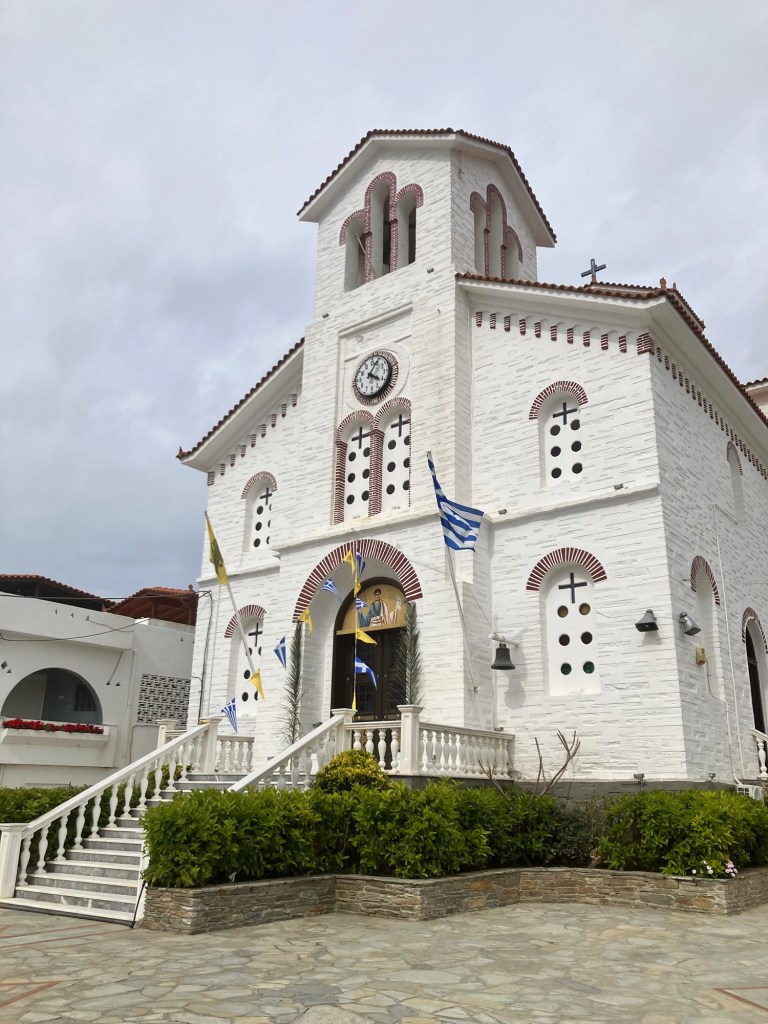
Like an off-broadway stage getting ready for theater season, Andros is placing the props, painting the backdrops, and rehearsing its lines to stage this 3 act play. Good Friday, Holy Saturday and Easter Sunday are the holiday; Easter Monday to recoup. I’ve never seen such a bonanza of excitement for a holy day. It’s like Mardi Gras and the 4th of July with a side of morality. The church rings its reminder on the minute this Good Friday from St. Phillipe up on the hill. On Saturday, the priests chant prayers transmitted through loudspeakers at the morning mass, voices that transcend the valley, climb the hills, seep into homes and kafeneons. By the Saturday night mass, you should feel your allotment of grace and mercy siphon through sufficiently enough for the libations to flow and the delivery of food on party sized platters.
I have just come off the hills from a four hour hike on this Saturday afternoon filled with the fragrant delights of wildflowers and herbs, and now have a good mind to enjoy a glass of retsina and light dish of Greek food to feed the ambrosial enticements from the hills. It’s my first restaurant visit away from the hotel (not that I am fabulously into my own food, but that after the midday meal at 3 there is less incentive to pile more on), and look for a place along an alley behind the port, in the shade, and away from the masses. I find Stamatis, which has apparently been serving food since 1965 according to the white paper covering over my table, situated on the corner of another little alley with a slice of the sea. No compromise here. I’m in the shade, I have the blue, and I’ll have the retsina, please. “Only a carafe, I’m sorry. Or the bottle.” the waiter replies to my requesting a glass. I ponder this conundrum. I love this conundrum. “I’ll take the bottle, then. I can take it with me, no?” Of course, he says. This is Greece.
From my view, I can see the children on someone’s yacht. Not overly presumptuous in length or design, a few of them have escaped their moorings and are enjoying a sail on the sea. But mainly, this one in particular and in my slice of a view, is anchored off the harbor and either chartered for a day or someone’s regrettable dream come true. Children, grandchildren, stepchildren, godchildren, or the can-you-please-just-take-my children storm the boat and begin clamoring about its decks with plastic swords and rubber floaties. They jump off its bow into the water’s cold embrace and I marvel at the vigor and vitality I must have once had as well as I wait for my wine. The food has been served, by now, you see. But no wine. I’m thinking maybe he had to run down the street for a bottle, so I wait patiently. In the meanwhile, I enjoy the Horta, the wild greens of unknown variety but tasting just like our homemade kind, and the fava beans, although they may actually be a yellow pea purée floating in a blend of honey and olive oil (I told you about the miracles of that oil, didn’t I?). I have learned to order with restraint and caution, and with good reason. The dishes come in mounds and enough for three.
And now the lunch crowd is coming in, tables are rearranged and joined for large parties. I enjoy hearing the demonstrative language and parsing the gesticulations of the waiters; seeing the return of old customers to their favorite places after months away, the welcome from the manager upon seeing these familiar people. I and my wine are apparently as forgotten as the Dutch and Germans who have been swept out to sea earlier. But no matter. It’s the Greeks I have come to see, in their life, their place, their living. They laugh and eat wildly. Large platters of seafood are brought to the tables with short introductions to its presentation, course after course. I walk inside to enquire after my wine. “Ah!” He laments, “I am sorry. I forgot. Do you still want?” Well, of course. This is Greece.
Sunday morning now, and I am downstairs drinking my dark muddy coffee seeped and boiled in the Italian coffee maker. Officially “off duty,” I enjoy the latitude to write and be still. Two new volunteers emerge with tousled hair and a look I know well. “Coffee?” Of course that’s it. One is originally from Colorado but has been living in Greece for ten years. His father got a job at the Athens airport way back when, and he decided to stay. He teaches music online, digital nomad style. The other is from England, and like the owner of the hotel, runs up mountains and back again. Like others in their generation, less emphasis is placed on stable careers and more on life experiences.
Our introductions are cut short by what appears to have been caused by a loose thread in the fishing net. Two Dutch ladies, maturely equipped with obstinacy and verve, have missed the sweep up, and are enquiring after breakfast. Rightfully so; it is after all close to 10 am. The alternate weekend buffet lady has not arrived on this post-festivity, Easter Sunday morning, rightfully so, and nothing is set out. So I hastily scramble to get things underway for the guests, which means putting out the boiled eggs cooled in the fridge, the yogurt, the milk and juice poured into their canisters, the platters lined with cheese and ham, feta cheese and vegetables, etc. Luckily coffee had already been made. But no sooner was I in the kitchen when one of them popped in and holding a cold boiled egg in her hand, asked, “Could you fry us up some eggs?” Of course. A few minutes later and I had nicely done fried eggs in butter and to their absolute delight. When they returned to the buffet for a second course, one of them skewed her face when tasting the milk. “This is bad!” It had been my thought as well the day before, but when I had the owner and his father taste it, they thought it was fine. I suppose one more day of the pouring in and pouring out of a canister was enough to curdle its rich nature. So I quickly went back to the kitchen and retrieved a new and unopened liter of milk.
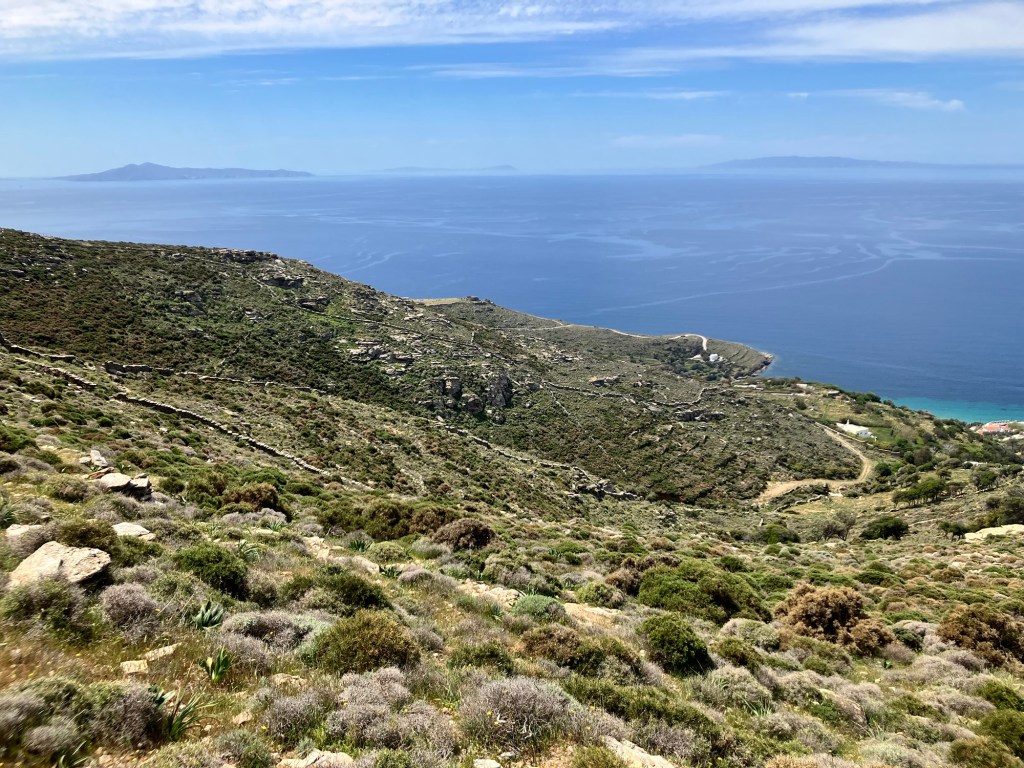
After breakfast I lace up and head back out to the hills. The silence, perfumed with chamomile, lavender flowers, red poppies and the like, the come and go of harmonizing bees, the sage bushes, the wild greens of the nettles and others – it’s all so aphrodisiacal. From the valleys, comes the Easter Sunday music, the Greek party happy music, turned up on whatever digital platform they use. I hear them from up here, clapping their hands to the rhythm, probably dancing in the traditional circle. Then I get a whiff of it: the lamb is grilling.
On my return, I’m greeted again by the Dutch ladies, coming in from an excursion of their own. “Could we have breakfast at 7:30? Because we need to be someplace, you know, before it gets too hot. And is the supermarket open? No? Then can you make us some bread and cheese sandwiches to take with us? Thank you. And for breakfast, can you make us an omelet? Yes? 7;30 then, and thank you.” Of course. I am breaking bad, or breaking Greek, and loving it.
D— the owner seems unfazed as to the absence of the weekend buffet lady, or maybe gave it no concern as the only two guests to emerge prior to ten were the marginalized few who thought it wise to stay on Andros for Easter. This is perhaps how the Greeks keep their heritage intact. They do deserve, of course, an island of their own.

 Write Down the Road